
Signs Pointing to a Bubble
There are growing concerns that parts of the AI market may be in a bubble. Valuations of AI-related companies have risen sharply, often well ahead of current earnings or proven business models. At the same time, trillions of dollars are being spent on AI infrastructure and capital expenditure, sometimes by companies taking on additional debt.
A Bank of America survey found that 54 percent of investors believe AI assets are already in bubble territory. Unsurprisingly, many commentators compare today’s environment to the late-1990s dot-com boom, when hype moved faster than fundamentals.
But Not Everyone Agrees
Some industry leaders see AI as the early stages of a long growth cycle, similar to the rise of the Internet. Nokia’s CEO Hotard, for instance, likens the AI surge to the Internet revolution, suggesting we are at the beginning of a long-term growth cycle. Others argue that AI is a foundational technology, like electricity or the Internet itself. From this perspective, current valuations reflect future potential rather than speculation alone.
Key Differences Between the AI Boom and the Dot-Com Bubble
There are clear differences between today’s AI Boom and the dot-com era in the late 1990’s. Many companies in the 90’s tech boom had no revenue, just an idea and a website. Today’s major AI players, including Microsoft, Nvidia, Apple, Tesla, and Alphabet, are profitable. Balance sheets are stronger as well.
Most large tech companies are cash-rich and funding AI development internally. As at the third quarter of 2025, they hold substantial cash reserves, with tens of billions of dollars each. In USD, Tesla $40 billion, Nvidia $55 billion, Microsoft $95 billion, Apple $55 billion, Alphabet $99 billion.
The technology is also more mature than the earlier 1990’s Internet start-up companies. Modern AI is built on established cloud infrastructure, not experimental networks. Speculation looks different too, with fewer IPOs and more consolidation. Unlike the dot-com era, AI already delivers tangible benefits across productivity, healthcare (in particular pharmaceuticals), and automotive sectors (self driving vehicles). Institutional investors also play a much larger role today than retail investors did in the 1990’s boom period.
Our Philosophy
Earnings multiples are currently extremely high for big tech companies like Openai and Tesla, reminiscent of the 2000 tech bubble. While some analysts believe these valuations are justified by efficiency gains, the verdict is still uncertain. A long-term investment approach suggests staying invested, but that may not feel reassuring.
Our view is that for late adopters AI appears to be easily replicable so big tech companies might receive significant cuts in their valuations. The advantages from AI will probably come through to smaller companies. This has also been observed by Bank of America. These smaller companies don’t have such high earnings multiples as the big tech ones and might be in a position where they can grow, improve faster, and increase their earnings multiples faster by embracing AI.
Our investment portfolios have a tilt towards smaller companies, more profitable companies, and companies with better balance sheets. This investment tilt makes our investment portfolios a little bit more resilient to the current higher valuations.
Are share markets really different today?
If you have a look at the S&P500 index over the last 40 years (logarithmic scale) the current market returns are not far out-of-line. The S&P500 index averaged 9.7%pa over this period.
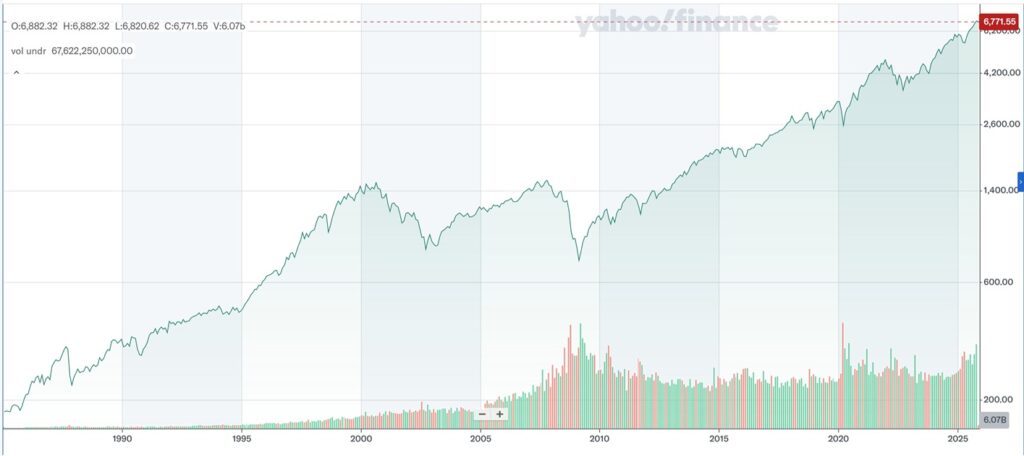
S&P500 Index over the last 40 years
Earnings multiples are high with some large tech companies and this could look similar to the tech bubble of 2000. While this is true, other analysts might also be right, in that the earnings are justified based on efficiency improvements. The verdict is not clear.
A prudent investment philosophy would be to invest anyway because you’re investing for the long haul.
Our investment portfolios have a tilt towards smaller companies, more profitable companies, and companies with better balance sheets. This investment tilt makes our portfolios a little bit more resilient to the current higher valuations.
Markets are not predictable (except in retrospect). Our portfolios are well diversified. If you are concerned then we could pull back your risk-return profile.
The slide below is interesting. This compares local newspaper headlines and the NZ share market returns over the following 12 months. The NZ share market did almost the opposite of what the newspaper headlines were predicting.
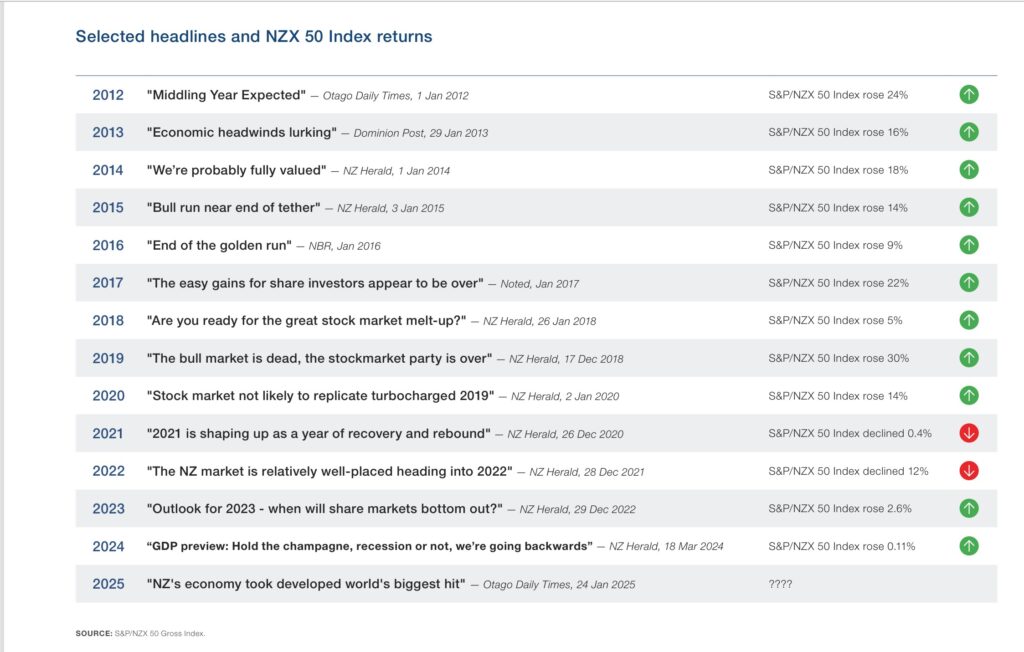
While valuations are high in parts of the market, they may still be supported by genuine earnings growth. Markets remain unpredictable, except in hindsight. Diversification matters. If concerns persist, adjusting the risk-return profile is always an option.